What usually goes unsaid is the question underneath the search — whether being sorry on your own is enough. The Church gives a precise answer to that, and it is worth more than another prayer.
Historical Context
There is no single official text. The 1973 Rite of Penance offers sample formulas and expressly permits others, which is why you will hear two or three different versions in the same parish. The traditional English wording is the one set down by the bishops at Baltimore in 1888, and it is still the most widely known.
The Act of Contrition
O my God, I am heartily sorry for having offended Thee,
and I detest all my sins, because I dread the loss of heaven
and the pains of hell,
but most of all because they offend Thee, my God,
Who art all good and deserving of all my love.
I firmly resolve, with the help of Thy grace,
to confess my sins, to do penance, and to amend my life.
Amen.
Notice the structure, because it is not decoration. Sorrow, then a reason for the sorrow, then a ranking of reasons — fear of hell first, then the better motive that outranks it — then three specific undertakings. It is a prayer that commits you to something.
The Shorter Form
From the Rite of Penance, and the one to use if the long text will not come:
O my God, I am sorry that I have sinned against you,
because you are so good,
and by the help of your grace I will not sin again.
Amen.
Does Being Sorry Count on Its Own?
This is the real question, and the Church answers it in two paragraphs that are worth reading slowly.
Contrition itself is defined as “sorrow of the soul and detestation for the sin committed, together with the resolution not to sin again” (CCC 1451). Then it is divided in two.
Perfect contrition — sorrow that comes from loving God above everything else. “Such contrition remits venial sins; it also obtains forgiveness of mortal sins if it includes the firm resolution to have recourse to sacramental confession as soon as possible” (CCC 1452).
Imperfect contrition, also called attrition — sorrow born of “the consideration of sin’s ugliness or the fear of eternal damnation.” The Catechism is careful to call this a real gift of God and a prompting of the Holy Spirit, and equally careful about its limit: “By itself however, imperfect contrition cannot obtain the forgiveness of grave sins, but it disposes one to obtain forgiveness in the sacrament of Penance” (CCC 1453).
So the honest answer is: sorrow is where it starts and it is never wasted, but for grave sin the prayer points toward the confessional rather than replacing it. Anyone who tells you the prayer alone settles a mortal sin is telling you something the Church does not teach.
Psalm 51 — the Miserere
Long before the Act of Contrition there was this, and the Church still says it at Morning Prayer every Friday and over the ashes on Ash Wednesday. It is the fourth of the seven penitential psalms and the oldest repentance prayer we have.
Have mercy on me, O God, according to your steadfast love;
according to your abundant mercy blot out my transgressions.
Wash me thoroughly from my iniquity,
and cleanse me from my sin.
For I know my transgressions,
and my sin is ever before me.
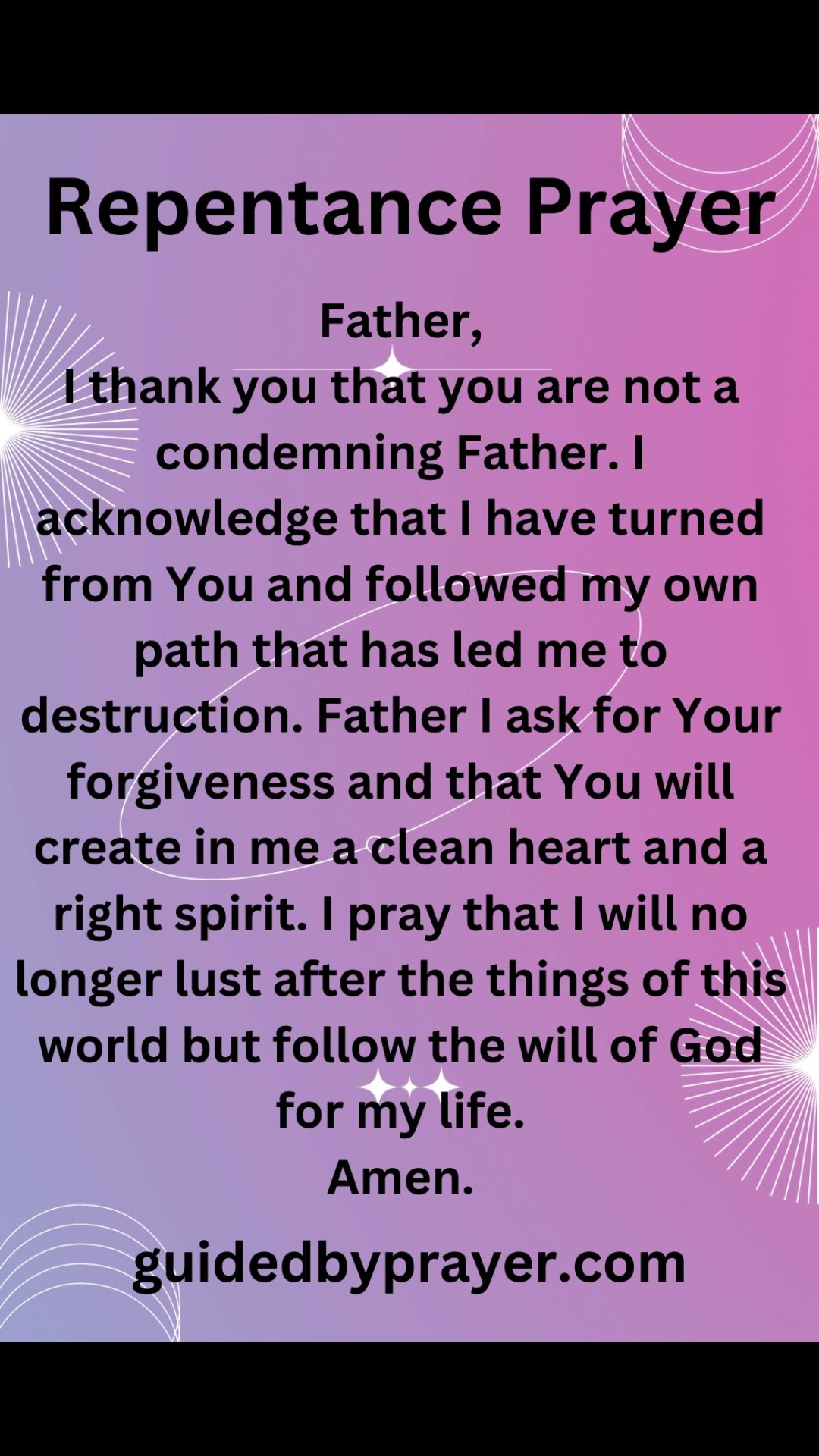
Create in me a clean heart, O God,
and put a new and right spirit within me.
Cast me not away from your presence,
and take not your Holy Spirit from me.
— Psalm 51:1–3, 10–11
What Repentance Actually Asks For
Three things are required of the penitent, and the third is the one people forget.
Contrition — the sorrow, which “occupies first place” among the penitent’s acts.
Confession — saying it out loud to a priest.
Satisfaction, also called penance — and the Catechism is blunt about what this means in practice: “One must do what is possible in order to repair the harm (e.g., return stolen goods, restore the reputation of someone slandered, pay compensation for injuries). Simple justice requires as much” (CCC 1459). Absolution takes away the sin; it does not undo the damage. That is left to you.
Best Times for This Prayer
- In the confessional, after confessing and before absolution.
- At night, as part of an examination of conscience.
- Immediately after a serious sin — and then make an appointment.
- During Lent, and on Ash Wednesday with Psalm 51.
- Before receiving Communion, for venial sin.
- When you cannot get to Confession yet and want to make an act of perfect contrition in the meantime.
Scripture Connection
“But the tax collector, standing far off, would not even lift up his eyes to heaven, but beat his breast, saying, ‘God, be merciful to me a sinner!'” — Luke 18:13
Seven words, and Christ says this man went home justified while the Pharisee beside him did not. The Pharisee’s prayer was longer, more detailed and entirely accurate about his own conduct. The difference is not eloquence and not even content — it is that one of them was asking for mercy and the other was reporting. It is worth measuring any prayer of repentance against that, including the ones on this page.
Related prayers
The Seventh Step Prayer and the Tenth Step Prayer are the recovery movement’s daily version of the same work, and the Resentment Prayer deals with the specific thing most often left unrepaired.
For the mercy side rather than the sorrow side, see the Memorare. St Augustine, who wrote the most famous account of a late conversion, and St Dismas, the thief who repented on the cross and was promised paradise the same afternoon, are both on the site.