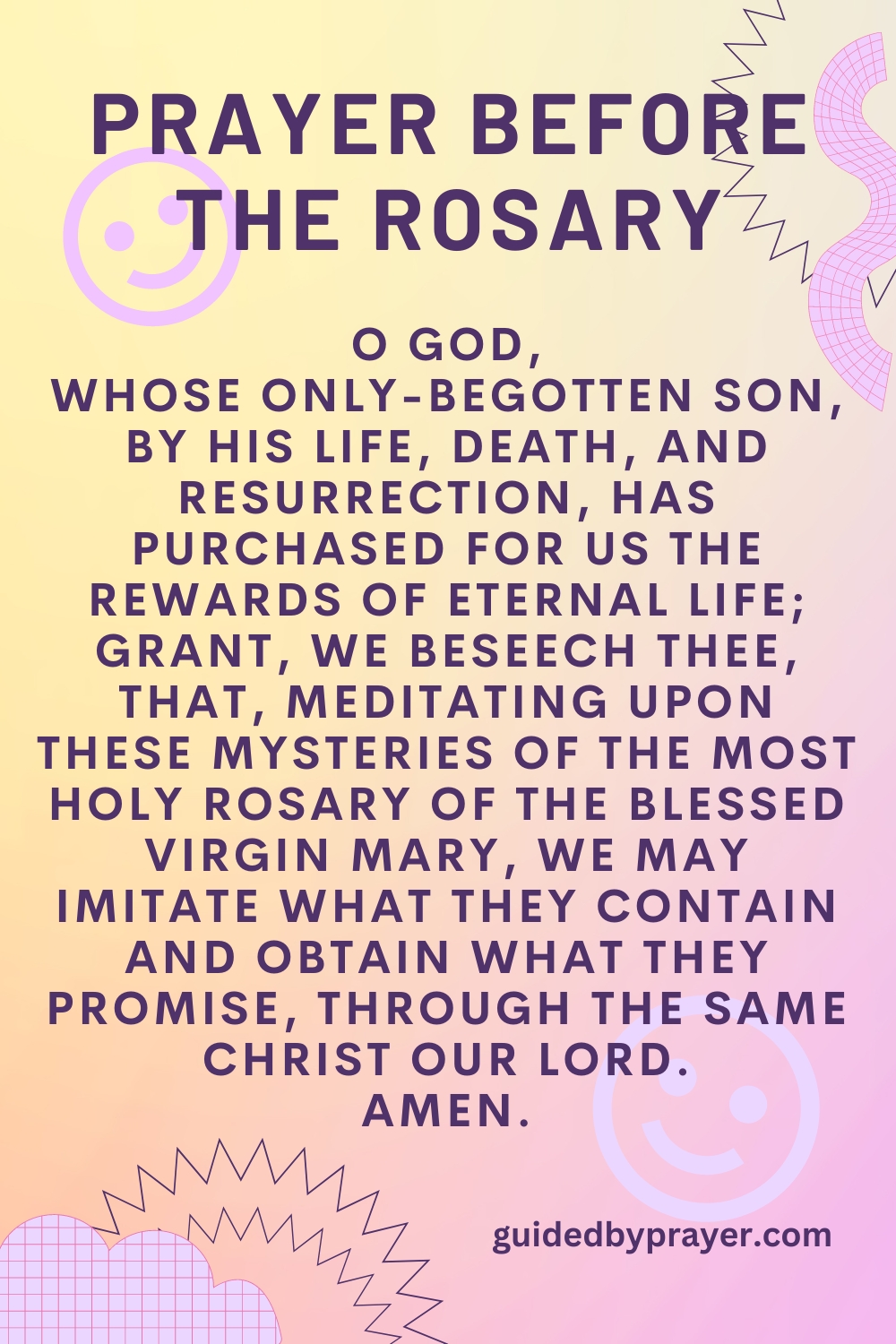
What is actually said before the Rosary is set out below, along with the best-known preparatory prayer, which is St Louis de Montfort’s.
Historical Context
How the Rosary Actually Begins
This is the opening, in order, and none of it is optional or regional:
- The Sign of the Cross, made with the crucifix.
- The Apostles’ Creed, on the crucifix.
- The Our Father, on the first large bead.
- Three Hail Marys, on the three small beads — traditionally for an increase in faith, hope and charity.
- The Glory Be.
- Then the first mystery is announced, and the first decade begins.
Before any of it, name your intention. That is the whole of what a “prayer before the Rosary” strictly needs to be: saying what you are saying it for.
Saint Louis de Montfort’s Prayer Before the Rosary
If you want an actual preparatory prayer, this is the one with a pedigree. De Montfort (1673–1716) wrote more about the Rosary than almost anyone, and this is his own introduction to it:
I unite with all the saints in heaven,
with all the just on earth,
and with all the faithful here present.
I unite with you, my Jesus,
in order to praise your holy Mother worthily
and to praise you in her and through her.
I renounce all distractions which may arise during this Rosary.
I desire to say it with attention and devotion
as if it were the last of my life.
Amen.
The last line is the point of the whole thing. Not “help me concentrate” but a decision made in advance about what this particular Rosary is going to be — which is a more honest way of dealing with distraction than pretending you will not have any.
A Prayer for Your Intention
Holy Mary, I am about to say this Rosary
for this intention, which I now name before you.
Take it with you into these mysteries.
Keep my mind on your Son and not on myself.
When I drift, bring me back without scolding me.
And if I get to the end having thought about almost nothing else,
count it anyway.
Amen.
And the Prayer at the End
For completeness, here is the prayer that is so often mislabelled — said after the five decades and the Hail Holy Queen:
O God, whose only-begotten Son,
by his life, death and resurrection,
has purchased for us the rewards of eternal life;
grant, we beseech thee, that meditating upon these mysteries
of the Most Holy Rosary of the Blessed Virgin Mary,
we may imitate what they contain
and obtain what they promise,
through the same Christ our Lord.
Amen.
“Imitate what they contain and obtain what they promise” is one of the best lines in the Roman liturgy, and it explains what the Rosary is for: not the recitation, but the twenty scenes you are meant to be looking at while you recite.
Best Times for This Prayer
- Before every Rosary, alone or with others.
- On 7 October, the feast of the Most Holy Rosary.
- Through October and May, the two Marian months.
- At the start of a Rosary novena, when you are naming the intention.
- When you are leading a group and someone present has never done this before.
- When the Rosary has gone mechanical and you want to start it deliberately.
Scripture Connection
“Blessed are you among women, and blessed is the fruit of your womb.” — Luke 1:42
Elizabeth’s greeting at the Visitation is the second half of the Hail Mary, word for word. The first half is Gabriel’s greeting at the Annunciation. Which means that before you add anything of your own, the prayer you are about to say some fifty-three times is made entirely of lines from Scripture — one spoken by an angel, one by a pregnant woman, both to the same person.
Related prayers
The Memorare is the other great Marian prayer to know by heart, and St Joseph has a traditional prayer said after the Rosary, added by Leo XIII.
For the mysteries themselves, St Benedict and St Martin de Porres were both known as men of the Rosary — Martin is titled “lover of the Most Holy Rosary” in his own litany.